Best Hooks for Product Videos (With Examples)
The first two seconds of a product video determine whether anyone sees the next forty. This guide breaks down visual, verbal, and text hook formulas with real examples — and explains how to test and iterate until you find what works for your niche and audience.
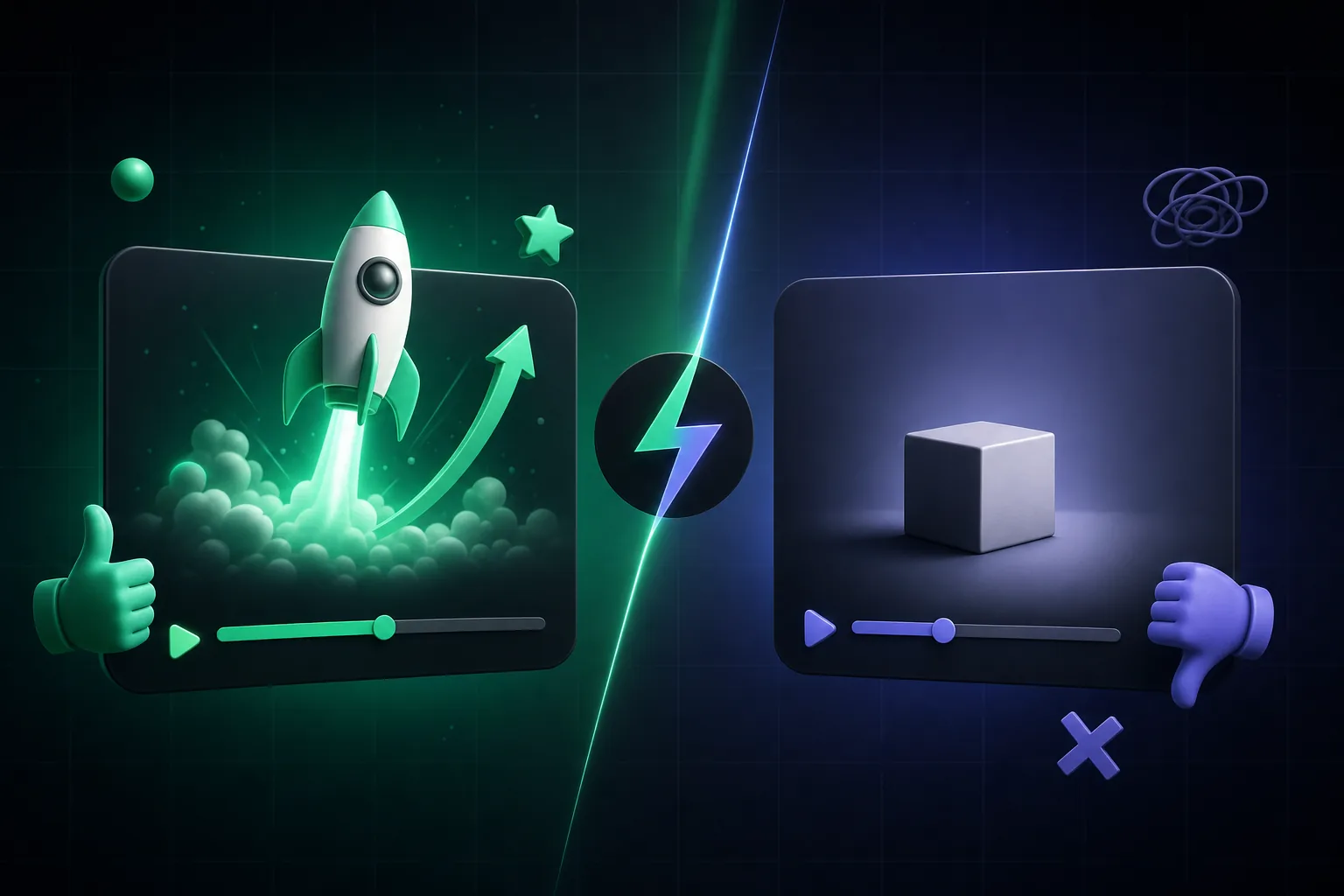
A hook is the first thing a viewer experiences — the moment that decides whether they keep watching or scroll away. For product videos, getting it right is not optional. Affiliate content lives or dies on watch time, and watch time begins with the hook. A great product with a weak hook will underperform a mediocre product with a strong hook, consistently.
What makes a hook "strong" in the context of product video is specific: it must create a reason to keep watching in two seconds or less. That reason is usually one of three things — a visual surprise that needs explaining, a verbal claim that creates a question in the viewer's mind, or a text overlay that names a problem the viewer recognizes in themselves. Often the most effective hooks combine all three at once.
What a hook actually is (and what it isn't)
A hook is not an introduction. "Hey everyone, today I'm going to be reviewing..." is an introduction — and it is the fastest way to lose viewers, because it tells them nothing they care about while burning the first five seconds they gave you. By the time you've said "today I'm reviewing," a large share of your potential audience has already scrolled past.
A hook is a promise and a pattern interrupt. It tells the viewer one of three things in the fastest possible way: what they'll gain by watching (a result, a solution, a discovery), what might go wrong if they don't watch (a mistake callout, a warning), or something unexpected that doesn't make sense yet and needs resolution. The last category — curiosity — is especially powerful because the only way to resolve the curiosity is to keep watching.
⚡ The two-second rule
On TikTok and Instagram Reels, viewers decide whether to stop or scroll in roughly two seconds — often faster. Your hook has to land its central idea within that window, before any introduction, context-setting, or product explanation begins.
The three types of hooks — visual, verbal, and text — each work on a different part of the viewer's attention. Combined thoughtfully, they reach viewers watching with sound, viewers watching on mute, and viewers who glanced at the thumbnail before the video started playing.
Visual hooks
A visual hook is what the viewer sees in the first frame, before any speech begins. On most platforms, the first frame of a video doubles as the thumbnail in the feed — it's the image someone sees before they decide to let the video play. A strong first frame functions as both a hook and a thumbnail simultaneously.
What makes a strong visual hook
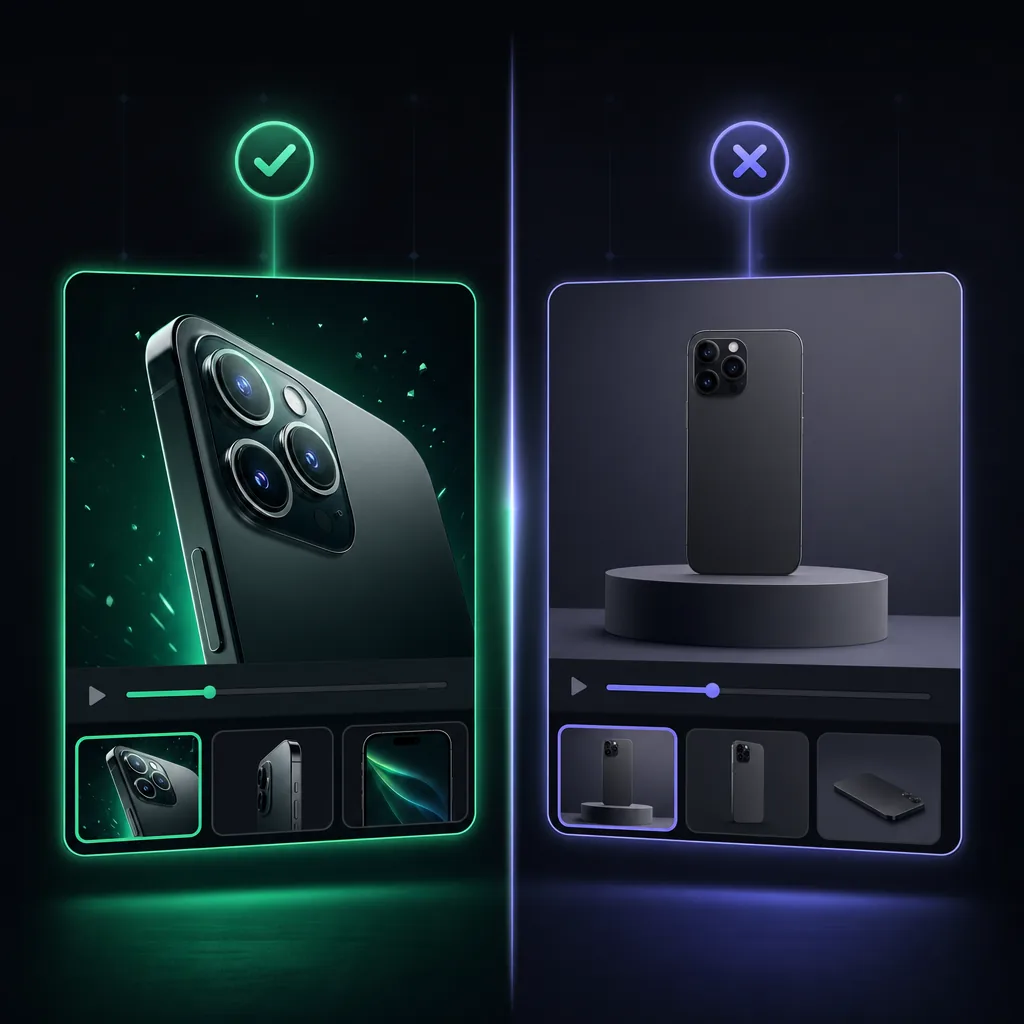
The best visual hooks for product videos share a common trait: they show a result or a moment of action rather than a static product shot. A product sitting on a table is informational. A product in use — removing a stain, dispensing something unexpected, producing a satisfying result — is engaging. The viewer's brain immediately generates a question ("how did that happen?" or "what is that?") that only the video can answer.
| Visual hook type | Example | Why it works |
|---|---|---|
| Result-first | Open on the clean surface before showing the product that cleaned it | Viewer wants to know how the result was achieved |
| Unexpected action | Product doing something counterintuitive (a tiny device lifting something heavy) | Pattern interrupt — viewer's expectations are violated |
| Before state | Open on the mess, the broken thing, or the problem, not the solution | Viewer recognizes the problem and wants the fix |
| Close-up texture | Extreme close-up of a product feature before pulling back to reveal context | Creates curiosity about what they're looking at |
| Transformation in progress | Mid-transition shot (stain half-removed, shelf half-organized) | Incomplete visuals demand resolution |
Verbal hooks
A verbal hook is your opening line — the first words out of your mouth. It's the element that reaches viewers with sound on, and it's the element most affiliate creators get wrong by starting with pleasantries instead of content.
Strong verbal hook categories
The result statement: Lead with the outcome, not the product. "My sink has been stain-free for three months, and it took ten seconds a day" is a result statement. The product that enabled it is implied but not named yet — that naming is what the viewer has to watch for. Result statements work because they bypass skepticism; the viewer hasn't been sold to yet, they've been shown evidence of a desirable outcome.
The mistake callout: "You're probably doing this wrong" and "I used to do this too, until I found this" are mistake callouts. They create both relevance (the viewer checks whether they make this mistake) and a mild social threat (correction is needed). These work especially well in categories where there's a clear right and wrong way to use or care for a product.
The bold claim: A specific, verifiable claim stated with confidence. "This thing paid for itself in two weeks" or "I threw away my expensive version after trying this $15 one." Bold claims work because they're falsifiable — the viewer stays to see if the video backs up the claim. An vague claim ("this is so good") does not create the same tension.
The relatable problem: "If your [specific problem], watch this." Naming a specific problem that the viewer likely shares creates instant relevance. The more specific the problem, the stronger the hook — "if your bathroom mirror fogs up every shower" outperforms "if you have trouble with your bathroom."
For a focused collection of opening lines calibrated specifically for TikTok Shop affiliate content, see our TikTok Shop affiliate hooks guide.
Text overlay hooks
Text overlay hooks appear on screen in the first frame or first second, independent of what's being said. They serve mute viewers — the people scrolling with sound off who would miss a verbal hook entirely. A text overlay that names a problem or states a bold result in the first frame can stop a mute viewer just as effectively as a verbal hook stops a sound-on viewer.
Text hooks work best when they amplify the verbal hook rather than repeat it verbatim. If the verbal hook is "I threw out my expensive version after trying this," the text overlay could be "Replaced a $120 brand with a $14 find" — same information, slightly different framing, and readable in under a second. The viewer who reads the text and the viewer who hears the speech both get the hook, but neither feels like they're reading a subtitle.
For text-hook formatting: large, bold, high-contrast text centered or upper-center in the frame. Keep it to one or two lines. If you're using the word-by-word animated caption style, the opening caption line functions as a text hook automatically — provided it starts with the actual hook content, not with "Hey" or "So."
10 hook formulas with examples
These formulas are starting points, not scripts. The best hooks feel natural to your voice — adapt the structure, not the exact words.
- Result first, product second: "My bathroom looks professionally cleaned, and this is all I used." [Show product]
- Price shock (positive): "I can't believe this only costs $12." [Show product in action]
- Before state reveal: [Show the mess/problem] "This is what my [space] looked like before I found this."
- Mistake callout: "If you're still doing [old method], you're wasting your time." [Show the better alternative]
- Curiosity gap: "I didn't think something this small could do this." [Show surprising result first, explain after]
- Replacement claim: "I returned my [expensive item] after testing this."
- Time claim: "This took me four minutes. I used to spend an hour on this."
- Specificity hook: "If your [specific problem], this is for you." (e.g., "If your car seats trap crumbs in the seams, watch this.")
- Social proof hook: "Everyone in my [group/family/office] has asked me what this is."
- Objection flip: "I thought this was a gimmick. I was wrong." [Then show proof]
Edit affiliate videos in minutes, not hours
YapCut turns raw clips into captioned, hook-ready affiliate videos — built for TikTok Shop, Instagram, and YouTube creators.
How to test hooks
There's no reliable way to know in advance which hook variation will perform best with your specific audience. The only valid method is testing — posting variants and measuring what the data shows. Here is a practical approach that works within a normal posting schedule:
The same-body, different-hook test
Film two or three different versions of just the opening 3–5 seconds of a video, with the same product demo and CTA after. Each version uses a different hook formula — for example, one result-first hook and one mistake-callout hook. Post them on the same day, ideally at similar times. After 48–72 hours, compare:
- Average watch percentage (the primary signal for hook quality — if people leave early, the hook didn't hold them)
- Total watch time
- Click-through to the product link
The hook that produced higher average watch percentage "won," and that formula should be your starting point for the next video in that niche. Carry the winning structure forward, not the exact words — the goal is to understand what type of hook your audience responds to, not to repeat a line.
Iterating across products
Hook performance is somewhat product-specific. A curiosity-gap hook works well for gadgets and unusual tools; a relatable-problem hook works well for cleaning, organization, and personal care products; a price-shock hook works well when the product is genuinely underpriced for what it does. Track which hook types work in which product categories and build a reference for yourself. For a comprehensive look at more TikTok-specific hook ideas, see our TikTok Shop affiliate video ideas article.
For the editing workflow that turns a filmed hook into a polished, exported video, the starting point is our guide to how to edit product review videos. The hook you film also needs to work on mute — see adding captions to product videos for how to make your first-line caption act as a text hook.
Common hook mistakes that kill your first two seconds
Understanding what to avoid is as useful as knowing what to do. These are the patterns that consistently produce low watch time in affiliate product video.
Opening with an introduction: "Hey everyone, welcome back to my channel" tells the viewer nothing about the product or the value they're about to receive. It's a courtesy pattern from long-form content that doesn't transfer to short-form, where every second of patience the viewer gives you has to be earned.
Showing a static product shot as the first frame: A product label or packaging as the first visual frame is the brand's job — not an affiliate's hook. The viewer doesn't yet have a reason to care about the product, so showing the product alone before establishing context or intrigue produces immediate scrolling.
Generic superlatives: "This is the best thing I've ever bought" and "You NEED this" are everywhere on affiliate content. They've lost meaning from overuse. Viewers have developed a pattern filter for these openers and skip past them automatically. Specificity is the antidote — the more precise the claim, the less it sounds like generic hype.
Giving away the whole video in the hook: A hook that fully explains the product, its price, its result, and why to buy it in the first ten seconds leaves nothing to watch. Hooks should create a question, not answer all of them. The question drives watch time; the answer earns the conversion.
Starting too slow visually: Panning slowly around a product, adjusting the camera, or walking to a setup position as the first visual action are all pacing failures. Motion, energy, and intent need to be in the first frame — the viewer's eye is looking for something to land on, and a slow pan gives them nothing.
Key takeaways
- A hook has two seconds to create a reason to keep watching. Introduction, context, and pleasantries have no place in those two seconds.
- The strongest product hooks combine a visual action, a verbal opening line, and a text overlay — reaching viewers regardless of how they're watching.
- Use one of four core verbal hook types: result statement, mistake callout, bold claim, or relatable problem.
- Test hooks by filming the same body content with different openings and comparing average watch percentage after 48–72 hours.
- Avoid generic openers, static product shots as first frames, and hooks that give away the whole video before it starts.
- Different hook types work in different product categories — track what resonates in your niche and build a reference.
Frequently asked questions
How long should a product video hook be?
Two seconds is the standard target on TikTok and Instagram Reels. The hook is complete when the viewer has a reason to keep watching — a visual surprise, a bold statement, or a curiosity gap that the rest of the video will close.
Should the hook be visual, verbal, or text?
The strongest hooks combine all three: a visual action or product reveal in the first frame, a verbal opening line that makes a claim or poses a question, and a text overlay that restates or amplifies the verbal hook for mute viewers. On its own, each type works — combined, they work on every viewer regardless of how they're watching.
How do I test which hook works best?
Film two or three versions of the hook with the same body content, post them as separate videos on the same day, and compare average watch time percentage and click-through to product after 48 hours. Keep the winning structure and carry it into the next video. Volume and iteration matter more than trying to theorize the perfect hook in advance.
What are the most common hook mistakes in product videos?
The biggest mistakes are: starting with an introduction ("Hey guys, today I'm reviewing..."), showing the product logo or packaging as the first frame without action, using a hook that gives away the whole video before the demo, and opening with generic phrases like "You need to see this" without any specificity about what "this" is.